Over a thousand species of corals call the waters of Maldives their home. The ones most at risk from the dangers of ocean acidification are hard corals because they use calcium carbonate to make their skeletons and create the structure of coral reefs.With rising ocean acidity these structures are dissolving and becoming more brittle therefore falling apart. Two varieties of these corals are massive and branching. Massive corals are characterized by their their slow and relatively flat growth while branching corals grow quickly and in a tree like manner (Goreau, 1979). A few of the common families of these hard corals inhabiting the warm
waters of Maldives include:
Pocilloporidae (branching)
Acroporidae (branching)
Faviidae (massive)
Poritidae(massive)
 |
| http://images.whatsthatfish.com/480x360/lleyu1nQ8l.jpg |
Agariciidae(massive)
 |
| http://images.whatsthatfish.com/480x360/nLf3tKDt8i.jpg |
Merulinidae(Massive)
 |
| http://fishoncomputer.files.wordpress.com/2012/02/img_81561.jpg?w=640&h=426 |
Siderastreidae (massive)
 |
| http://images.whatsthatfish.com/480x360/tfcrrz66NZ.jpg |
 |
| Image/Text/Data from the University of Illinois WW2010 Project |
In
1998 Maldives coral reefs were devastated by a major El Niño event that damaged
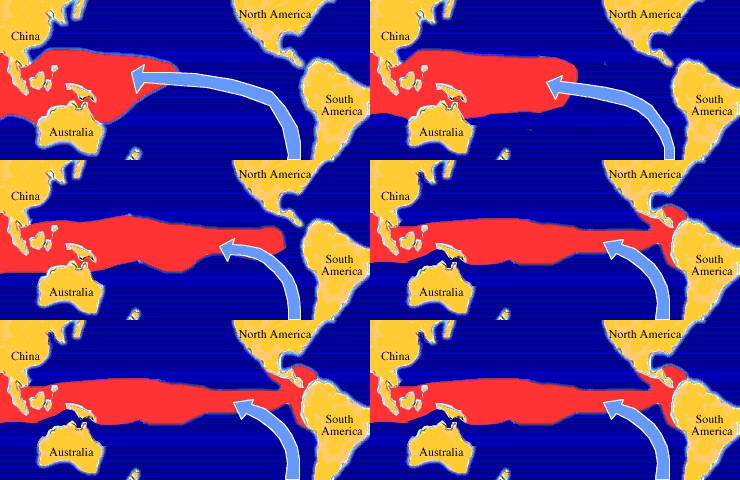
most of the surrounding reefs. An El Niño event is cause by a weakening in Easterly trade winds (Easterly winds come from the east and move west). This allows warmer waters from the Western Pacific to disperse causing an increased SST all along the equator ("El Nino..", 2010). Researchers were able to study the effects and gain a lot of insight on not only how corals respond to bleaching events, but also how different species react. Scientists constructed artificial structures
in 1990 to monitor species ratios. It was found that the El Niño warming event
caused 98% of the branching corals to die while the majority of massive corals
managed to survive (Edwards, 2001). This death rate caused by the warming event creates two
very different community structures when comparing the pre and post bleaching
populations. Pre-bleaching coral community consisted of 95% branching and 5%
massives at a total population of 1589 individuals and then after 1998 switched
to 3% branching corals and 97% massives with a much smaller population count of
248. These results were also seen by another study conducted by Dr. McClanahan. His team found that the community structure switched from large number of branching to massive corals. He predicted that if climates continue to rise, there will be a permanent change in family composition of coral reefs (T.R McClanahan, 2000).
 |
This figure shows how the community is composed of more massive corals
rather than branching but begins to revert back as times passes (Edward 2001) |
From these results, it is apparent
that branching corals are very poor at handling the increase in temperature.
Massive corals are able to cope with this change much more effectively which is
most likely due to thick protective tissue compared to the tubular formed
branching corals with their thinner tissues.
However, the graph demonstrates that community structure appears to be
shifting back to the original proportions.
This is likely due to the slow growth rates of the massives compared to
the branching species which are able to propagate much more quickly in the
ideal cooler conditions.




What is hard coral? Also, i feel this one should follow your explanation of coral bleaching because it gives a clearer picture to your reader what you are talking about.
ReplyDeleteThis is a great page. I liked all the visuals but I would like to see a maximum two sentence description of what the types (hard, massive, branching) are how they differ. This will help your readers understand the results you present in the last paragraph. Also, don't forget to include your in text citations or note where you are getting this information from.
ReplyDeleteLove this page, but I would like to know alittle bit more on what I am seeing in the pictures as Patrick mentioned above.
ReplyDelete